Showing posts with label Ryron Gracie. Show all posts

Thursday, April 24, 2014

Chess and Jiu-Jitsu: Destruction of A Guard


Chess and Jiu-Jitsu: Destruction of A Guard
By: Adisa Banjoko, Founder of Hip-Hop Chess Federation  


I play chess, but my past is checkered/ The mic and I are like staff and sheppard/ When I apply science, my maths perfected, gotta move with proper tools for task selected - Ka, Peace Akhi

In the interest of furthering the discussion on chess and jiu jitsu, I wanted to share a reflection I've given thought to for quite some time. I find the connections between chess and jiu jitsu fascinating to the mind and enlightening to my heart. The interconnectedness between these arts and sports has given me much genuine inspiration over the years.


Recently I have been combing through tons of old DVD’s and  of VHS of classic jiu jitsu matches from the late 1990's. I’m talking about early matches with legends like Roleta, Marcio Feitosa, Mario Sperry, Terere, Jacare, Saulo Ribero, Fabio Gurgel, Gordo- all the OG’s. Its really exciting to observe how certain techniques disappeared while others stay or evolved. I have to assume that looking back in chess history certain evolutionary themes rise and collapse over time. Nevertheless some elements never will never die.


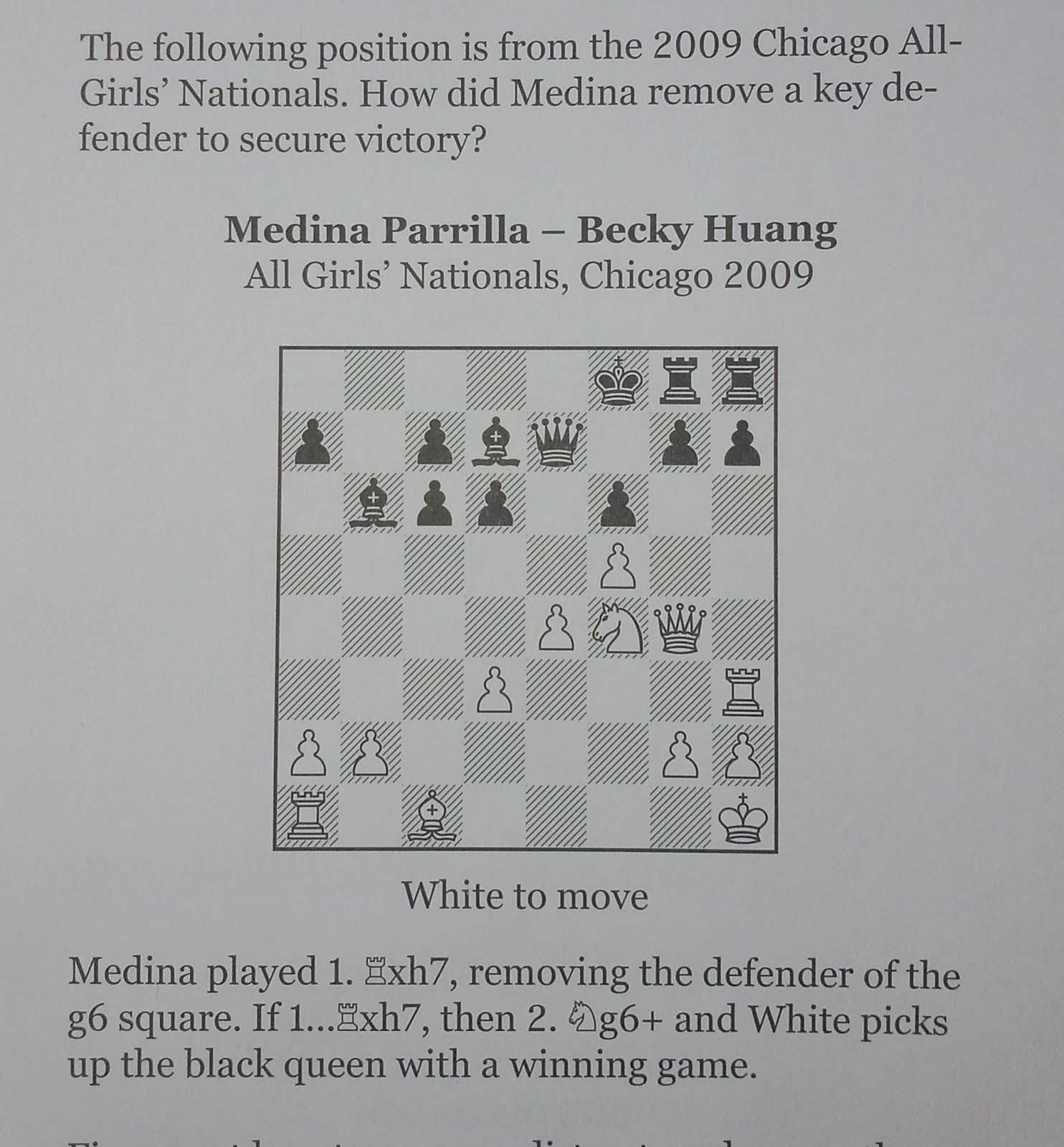
In chess, there is a theme called Destruction of a Guard (or removing the guard). Essentially it’s a tactic where you focus on attacking the pieces that are protecting the bigger pieces you are going after. Maybe its a knight in front of a queen you hope to capture. There might be two pawns and a rook preventing you from getting to the king. The process of capturing those pawns and rook, or getting them to move off of the squares they are on- is destruction of the guard.


Jen Shahade has a great chapter on this topic in her amazing book Play Like A Girl.


destructionchess.jpg


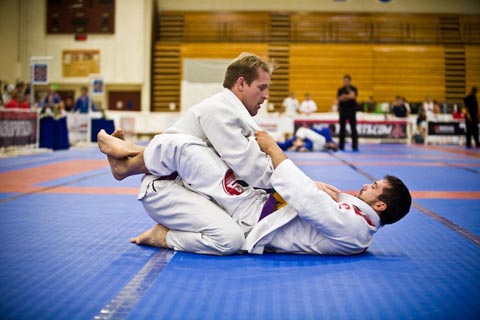
When people watch MMA and BJJ, there is a correlating physical position call “the guard”. Traditionally it's called "the closed guard" where one person is on their back (with a person on top of them, who is attacking) but the person on the bottom has both of their legs wrapped around their opponents torso. This takes a lot of mobility away from the person on top and leaves them vulnerable to direct attacks and reversals. For the person on top, until he or she gets past the person on the bottoms legs, it will be almost impossible to win. They must “destroy the guard”, commonly referred to in BJJ as “guard passing.”  I should note that there are many guard variations outside of the closed guard including "open guard", "butterfly guard", "X guard" and "rubber guard" among others. Each have their own nuances that turn every match into a positional  minefield (much like chess).


Jiu_Jitsu_Closed_Guard.jp
The jiu jitsu player on the bottom wrapped his legs around his opponent's torso securing the closed guard.


Here are some easy to understand examples of the countless elements of guard passing in jiu jitsu.  Jason Scully also has a cool video about guard passing that shows you many of the positional variations  when passing someone's guard. Having clarity in the full balance of power within the position, understanding threat assessment and your opponents  potential counters are key. Destroying the guard on the chessboard or the mat can be tricky at best, dangerous every time and if done without full focus- absolutely fatal.


A secondary theme in the concept of “destruction of a guard” in jiu jitsu is when one opponent is on top (after passing the guard and transitioning to the mount) and is trying to secure an armlock. However, his/her opponent (knowing they  are in danger of tapping out soon) defends the armlock by grabbing their opposite arm, or gi to prevent hyperextension of the elbow joint. Ryron and Rener Gracie have a fantastic presentation on various tactics people use to defend the armlock. Their video is a perfect illustration of the destruction of a guard.


Womens MMA sensation Ronda Rousey breaking the defending grip of her opponent to finish the armlock.


Without question the parallels between chess and jiu jitsu are as numerous as the potential moves within the two arts. I will post more on this relationship soon. Feel free to email me about your thoughts on chess and jiu jitsu at bishop@hiphopchessfederation.org!


Wednesday, April 16, 2014

Rapper Kalhi from Street Games Vol 1 Drops New Round 1 Mixtape !!!


When the HHCF dropped the Street Games Vol. 1 Mixtape with DJ Rob Flow, there was a huge positive response around the world. Nobody expected a profanity free mixtape to be so lyrically aggressive and educational. Rapper Kalhi, based in Geneva Switzerland had arguably one of the mixtapes most standout tracks with A Technical Flow which featured UFC Coach Ryron Gracie. If anyone had any questions about the connections between Hip-Hop, chess and jiu jitsu- he answered them!! Kalhi recently dropped a new mixtape called Round 1 which you can download right now! In the tradition of Gangstarr, Nas and others he gives his heart to the mic. Its a very impressive mixtape in terms of its production and lyrical content (though kids will want to get their parents permission). In this interview we talk about the impact rap had on his life, being raised between The Bay and Geneva, his love for martial arts and his plans for the future.

Where are you from.and what are your earliest memories of rap?

I was born in Berkeley California. My father is from the Bay Area but my mother is from Geneva 

Switzerland. When I was a few months old, my parents decided to move to Europe, so that’s 

where I grew up until moving back to the Bay at 18.

My earliest memory of rap was when I was about 5-6 years old. A friend of the family got me 

my very first album as a gift, it was Mc Solaar (french rapper who you might know from a Guru 

feature back in the day). No turning back ever since… 

I understand you learned English from Tupac and Nas albums? Is that true?

Yeah in a sense that’s true. I definitely got the basics from my father speaking to me in english 

as a child, but the way I talk and especially the way I rap was molded from listening to Pac and 

Nas mostly for sure. That’s why I can say that in a sense I learned a lot of my english through 

hip hop and movies. 

What else have you learned through Hip-Hop?

I really feel like Hip Hop was my third parent in a sense. I was conscientious enough as a kid 

to pick the right artists to listen to, but I learned so much I wouldn’t be able to list any particular 

thing. Hip Hop IS part of me, and who I am period. Hip Hop helped raise so many kids, and I 

was no exception. 

Tell me about your latest project?

I have a mixtape coming out at the end of january 2014. It’s been a LONG time coming! I’ve 

been rapping for about 14 years on and off, but never took it seriously until last year. This 

project is my “baby” in a sense. This one sets the bar for what’s to come this coming year for 

sure.

You also have a history with martial arts. Tell me about that.

Hip Hop and Martial Arts are the two main pillars in my life. If you want a common denominator 

to anyone I have met and done business with or anything in between for that matter, you can 

literally trace it back to either Hip Hop or Martial Arts (specifically Muay Thai and Jiu Jitsu). 

I started my Martial Arts journey when I was 6-7 years old with Judo…then stopped after a 

couple years to play soccer (like every kid in Europe), but got back into it with kung-Fu when 

I was 11. From there, I heard about Muay Thai when I was 14 and never looked back! Fast 

forward to 2007 when I started Brazilian Jiu Jitsu with the Cesar Gracie Fight Team. Since then, 

I’ve been training mostly Jiu Jitsu, but was also teaching Muay Thai at Jake Shields MMA gym 

while I was a student at UC Berkeley.

You got a huge response from the CTRL Industries ad. Did you expect that?

To be honest I didn’t really know what to expect. But one thing I knew for sure is that it’s really 

difficult to mix rap with a certain “sport” and not make it sound all corny and wack…so I do feel 

like I was able to bridge the gap between hip hop/chess/and martial arts on that one song pretty 

nicely, while still keeping the true essence of Hip Hop intact.

Any last words?

I want to thank all the people who believed in me when I didn’t believe in myself. I want to thank 

my family and girlfriend for always being there for me, and my close friends as well. I also want 

to thank everyone around me who’ve been supporting me from day one, they know who they 

are.

Download his new mixtape Round 1 at www.kalhimusic.com 

Sunday, January 12, 2014

BREAKING: RZA to Defend Chess King Title in LA!!

Wu-Tang Clan Leader RZA Defends HHCF Title at Chess Kings Invitational in Los Angeles
Hip-Hop Chess Federation Hosts Celebrity Chess Tournament to Help South Central LA  

Los Angeles, CA 1/13/14- The Hip-Hop Chess Federation (HHCF) is proud to announce that it will host its upcoming Chess Kings Invitational , a celebrity chess tournament, at the Anaheim Business Expo on Sunday Feb 16th 2014. Wu-Tang Clan leader RZA will defend his title in an 8 man speed chess tournament. RZA won the first HHCF heavyweight title belt in 2007. See video here.

The HHCF will be teaming with a submission only (tapout only, no points) Braziian Jiu Jitsu tournament called the KO Finisher for the event. Some of the biggest names in jiu jitsu will gather together to prove their skills. A portion of the ticket sales will help the HHCF expansion into Los Angeles.   

Hip-Hop Chess Federation Founder, Adisa “The Bishop” Banjoko stated “The HHCF is very excited to be hosting an event in LA. No one has ever seen anything like what we are about to do. This event will help get HHCF the funds to start to after school programs in South Central Los Angeles. I have chosen Santee High School as one, and the other will be determined by RZA, our Director of Outreach. The HHCF is grateful to Kurt Osiander, Nick Greene and everybody at the KO Finisher for allowing us to join forces. Together we will showcase the power of jiu jitsu and chess to the planet.”

The events that day will include HHCF’s Founder giving a short 15 minute presentation on the philosophical connections between chess and jiu jitsu. The HHCF will also host a Mind Over Matter Panel featuring RZA, as well as notable chess masters,  martial arts masters and educators. It will be a discussion on how Hip-Hop, chess and martial arts can lead American youth to unity, strategy and nonviolence.

Dilated Peoples Rakaa Iriscience, Mike Relm, DJ Rob Flow and Quadir Lateef will be on hand and other special guests will be announced shortly. In related news, the HHCF recently releasedStreet Games Vol. 1 hosted by DJ Rob Flow and A-Plus of Souls of Mischief. Street Games is a profanity free mixtape about the connections between Hip-Hop Chess and martial arts. It includes A Technical Flow by Kalhi feat. UFC coach Ryron Gracie, 64 Squares in the Cipherby Sunspot Jonz, Zumbi and Rakaa IriscienceThe Chess Clock by Quadir Lateef and Jasiri X, and The Maurice Piece, a tribute to the first Black Grandmaster of chess, Maurice Ashley.

RZA has a message for those who seek to take his title: “I am looking forward to the upcoming chess battle at the HHCF Chess Kings Invitational in Los Angeles. To those knowing I have to defend my belt, get ready to protect ya neck.”

A full schedule of events for the Chess Kings Invitational will be posted shortly at
 www.facbook.com/hiphopchess


Monday, October 21, 2013

NEW EXCLUSIVE MUSIC: A Technical Flow by Kalhi feat. Ryron Gracie


Check out the latest track to be shared from HHCF Street Games Vol. 1. This track is called A Technical Flow and it features Ryron Gracie breaking down what the essence Gracie Jiu Jitsu is.

LISTEN HERE: A Technical Flow

Read the annotated lyrics at Rap Genius!

HHCF Philosophy: A Technical Flow: Chess and Jiu Jitsu

A Technical Flow: Chess and Jiu Jitsu

By: Adisa Banjoko


On the mat I battle cats, the same way I’ll take your back/  A strategized a plan of attack- Kalhi  A Technical Flow

zug·zwang

   [tsook-tsvahng] A noun
In chess a situation in which a player is limited to moves that cost pieces or have a damaging positional effect.


For many years people have discussed the connections between chess and martial arts. I’ve been a casual student of chess and jiu jitsu for a while and I have seen many overlapping themes. My earliest memory of the correlation is watching Rickson and Royler Gracie play chess before one of Rickson’s matches in the movie Choke. In recent years we have seen the emergence of the Checkmat team (known for being very aggressive and strategic in competition) and recently an instagram photo of champions Roger and Kyra Gracie playing chess in their gi’s popped up on the net. If that was not enough, jiu jitsu clothing brand CTRL Industries has dropped a limited edition set of gi’s named after chess pieces. “The Rook” and “The Knight” have gained a lot of internet buzz among jiu jitsu players online. Little by little the connections seem deeper and more authentic.


In his book Black Belt Techniques, Jean Jacques Machado wrote “As in a game of chess, you don’t simply concentrate on taking one piece; all your moves contribute to an overall plan. An advanced student already has engraved in his mind a set of positions, along with the natural reactions that these positions will induce in his opponent.”  


I train at Heroes Martial Arts in San Jose, CA. Its a very cool school. I don’t say that from a place of arrogance. We have some tough dudes there. Some world champions, some national champions and some unknown, ridiculously rugged folks on that mat.


Our head instructor Alan “Gumby” Marques is pretty amazing. He’s a quiet dude. Very deep intellectually and technically. He never says or does anything more than he needs to. I don’t say that lightly, to suggest he’s lazy.


On the contrary he’s got a serious work ethic. One so big that when his instructor Ralph “The Pitbull” Gracie handed him a black belt...it was the one on Ralphs waist, that he handed to Gumby.


On your first day of class at Heroes, you’ll be taught the essence of what Gumby thinks jiu jitsu is about, and life: Safety, Position, Finish.


That’s it. Sounds so simple but it's so complex.


Essentially Gumby feels your first job in any conflict is safety. Get yourself safe from whatever is coming at you. After that, do what you must to improve your position. It can be a quick substantial movement, or it can be in incremental inches. Once you have achieved the best possible position, end the conflict by finishing them. In jiu jitsu, it would be a submission hold ( a choke, armlock, wristlock, kneelock, footlock etc.). On the chessboard, its checkmate in 5, 4, 3, 2, 1.


Gumby believes that this method is what’s best on the mat, in the boardroom, on the chessboard etc. No matter your conflict, you can use the “filter” of safety, position, finish to assess, re-evaluate and elevate your situation with great clarity of mind and purpose. Its so beautiful, I believe it shines brightly in the shadow of military minds like Sun Tzu and Machiavelli.


So much of what we learn about jiu jitsu is related to the chess theme known as Zug zwang. I first learned of this going through the Chessmaster game in the Josh Waitzkin academy. For those unfamiliar with the term, Zugzwang means to put your opponent in positions that force them to make positionally or materially worse position again and again until there is nothing left.


In jiu jitsu, one of the most ideal positions is called The Mount. I’m not really sure who “discovered” the immense value this position, but Carlos and Helio Gracie (founders of the Gracie Jiu Jitsu system) created an entire methodology  based on its importance.  From this position you are pinning your opponent with your hips, and arms (kind of like the skirmishes you might have gotten into with your older brother or sister. Once there you can change the pressure on the chest and the belly. You can threaten the neck with chokes or torque the shoulder. Or, you can just smother your opponent with clean movements until panic sets in and they move right into another position called The Back Mount which essentially assured almost no effective defensive responses. At that point a choke called “The Lion Killer” is applied and the match is over.


This video of Helio Gracie’s grandsons Rener and Ralek Gracie is a clear illustration of zugzwang elements within the jiu jitsu methodology.


I caught up with Josh Waitzkin,  the American chess icon and Black Belt in jiu jitsu under Marcelo Garcia . I asked him about zugzwang. He told me “A lot of heavy guard passes play on this principle. Fabio Gurgel [legendary BJJ fighter and coach] embodies it hugely. In chess, the dynamics of "opposition" with king and pawn vs king are the easiest way to help people understand it. Adding  “King  and pawn vs pawn positions are mutual zugzwang.”


Rey Diogo Black Belt Oliver Reich says he sees the connected themes of zugzwang and jiu jitsu as well. “When guard passing leads to positional control,  guiding their opponent  into chained submission attacks- its almost identical to zugzwang.”


Observe Henry Akins perspective on guard passing. The positional shutdown illustrated here screams zugzwang to me.


As much as I love chess, I’m nowhere near a master level of playing. I needed to talk to someone who could help me drill down a bit on the concept. I called Dr. Daaim Shabazz, founder of the chess news and culture  website The Chess Drum to ask him his thoughts on zugzwang.


“Seeing zugzwang emerge in a chess game takes quite a bit of understanding and experience” said Dr. Shabazz. “Many world-class players can see certain patterns emerging that restrict an opponent’s options. It may be capturing control of squares or restricting the opponents ability to execute their own plans. In jiu jitsu you have many of these scenarios where submissions are set up because the opponent no longer has any viable options to escape. “


“Thus it is not the submission itself that is the focus, but the way it is set up. In chess, it is similar. The process of restricting an opponent until they cannot move any pieces is an intricate one and one that totally demoralizes the other player. Usually when the player is suffocating, they will try to break free all of a sudden. In chess, as well as jiu jitsu, this is a mistake since that person leaves themselves exposed while trying a sudden tactic or escape. However, in chess it is also easy lose concentration and allow an opponent to escape from your vice grip and turn the tables. Sun Tzu taught that you should always provide an opening for an opponent so that they will not fight so ferociously. However, in zugzwang, the opening also leads to an immediate loss.”


To share a clearer idea of how this plays out positionally in chess, Dr. Shabazz gave a great example.


“I recall former World Champion Garry Kasparov playing the computer Deep Blue (developed by IBM) in 1996. In this game, Kasparov developed a lasting space advantage with a simple opening called the Reti. In those days, you could play positionally and watch the computers go astray because they lacked deep positional understanding. Slowly, but surely, Kasparov continued to grab more and more space from the computer. It is like being in a dominant position in a grappling sport. He then closed the position giving the computer fewer options, but appeared to give the computer a way out by sacrificing a pawn. However, this sacrifice gave Kasparov an even tighter grip on the position. In the final position, the Deep Blue team resigned since the computer had absolutely no moves, yet many pieces were still on the board! “


WATCH HOW THE GAME PLAYED OUT:


Of the many similarities between chess and martial arts, specifically jiu jitsu I find this to be the most profound. Zugzwang is always masking itself. On the board a seemingly silly blunder by your opponent incites you to quickly snatch up a knight- only to find the horror of a discovered check. Prepositioned pawns and bishops cut the board off, giving the king little room to breath. Its almost as if your opponent is saying “I am everywhere.” That discovered check soon walks the king slowly to the gallows- zugzwang.  


Daaim trains in Capoeira but his understanding of chess and jiu jitsu methodologies make him sound like a seasoned guy on the mat. “The ability to create a zugzwang takes positional understanding, knowledge of opponent’s tendencies and excellent planning. These skills are developed by a depth in the understanding of the middlegame where advantages are lost or gained. This is also where one’s wealth of experience comes in. Again zugzwang maneuvers are rare in chess and often occur in the endgame, but when they do occur in the middlegame, they are instructive since it usually shows complete mastery over an opponent.”


The first step in developing zugzwang is really just doing one move checkmate chess puzzles that help you see the reality of the situation for what it is. This is clearly a benefit of chess that helps martial artists as well as average citizens. Once the reality of the situation is clear, you can then observe and innovate on the potential future in the game,a jiu jitsu match or your life in general.


RZA from Wu-Tang Clan is one of Hip-Hop’s most talked about chess players. He writes about the many connections between chess and life in his book,The Wu-Manual. I’ve played him and lost twice. Most recently we played at the Rock The Bells tour when it came to The Bay Area. The thing I noticed about his game this: He sees a greater potential threat in your moves before you do. He slowly cuts them off. By the time you realize what could have happened, you’re immobile. Its almost like for him zugzwang is in play from the first move. Reminds me of rolling with my instructor, Gumby. Its impressive.


The clarity of mind that comes from doing one move checkmate puzzles is how I try to cultivate my eye for zugzwang. I get the most fun reading Eric Schillers One Move Checkmates or Play Like A Girl, by Jen Shahade.  A few times a year or so I test my “chessvision” with those books . Another great one is the Chessmaster video game puzzles.  You think you see all the entries and exits that are blocked for the king and its not there. You try to move the bishop when its the rook that gets it done. You over think the position and try to smash with the queen when its the pawn that lands the final blow. That last scenario is so crucial to understand. Its why my instructors personal way of always using exactly the right amount of effort for any job is so mind blowing. The Confucian teachers from the Ming dynasty had a quote that resonates with me when I think of those situations. “To go too far, is just as bad as not going far enough.” Focused effort, the right tools for the job, proper planning, zugzwang.

Adisa Banjoko is the founder of the Hip-Hop Chess Federation. He holds a purple belt at Heroes Martial Arts in San Jose, CA. For more information visit www.facebook.com/hiphopchess


Friday, August 16, 2013

Every parent MUST watch this!!


Much love and respect to Ryron, Rener and Ralek. The Gracie family, the Gracie WAY saves lives...See just one right here.

Uproxx Covers HHCF Founder plus, FREE PDF download of Bobby Bruce and the Bronx Available

The book Bobby Bruce & the Bronx by Adisa the Bishop is now available from this day forward FREE in PDF form. Please enjoy it and share ...