Why Don’t The Black Kids Like Math and Science?: Easy Answers
By: Adisa Banjoko and Arash Daneshzadeh
Some ask why we act the way we act, without lookin’ how long they kept us back- Public Enemy, Rightstarter
I took a job working as a security guard for about five years while doing guerrilla research for my non-profit (Hip-Hop Hop Chess Federation) to help at-risk kids at John O’Connell High School in San Francisco. At the time, “OC” had a solid reputation as a tough school. In my five years there I learned a lot about youth violence, teen eating disorders, teen pregnancy and alcohol and drug abuse. What I saw and learned changed me as a parent and a teacher forever. One of the main things I learned was about why kids don’t learn.
For the record, that school has many loving and competent teachers in the space of math and science. However, “Why don’t the Black kids like math and science?” was a common question. The answer for me, as a Black male who was transformed by books like Golden Age of the Moor by Dr. Ivan VanSertima, African Presence in Early Asia by Dr. Runoko Rashidi and The Black Man of The Nile and His Family by Dr. Yosef Ben Jochannan was very easy.
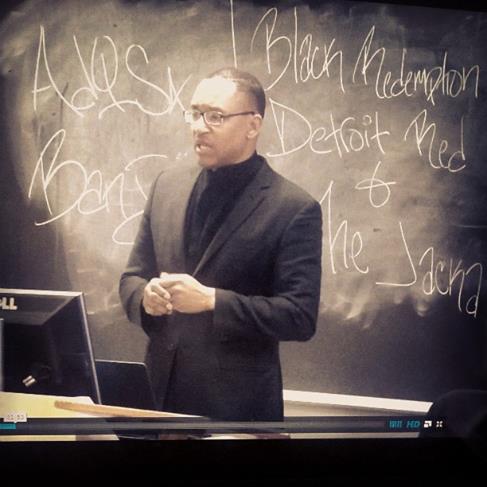
HHCF Founder, Adisa Banjoko teaching Hip-Hop history.
“You must tell them their cultural and historic connections to the subject. The kids are feeling like they have no connection to the formulas and concepts they are being shown. If you teach this as part of their cultural legacy, it will be more exciting to digest.”
My own son was actually home schooled from the 6th grade to the 11th because my wife and I saw many unfair biases in the way the teachers treated him. When my wife first began teaching him algebra he was very unexcited. Then I told my son about Moorish achievements in mathematics, cartography and architecture. David Shenk’s chess book The Immortal Game illustrates how one Moorish scholar of the era used the chessboard, as an abacus! His eye opened a little wider.
I showed him a section of John G. Jackson’s Man, God and Civilization that reads: Students flocked from France, and Germany and England to drink from the fountain of learning which flowed only in the cities of the Moors. The surgeons and doctors of Andalusia (what Spain was called at the time) were in the van of science: women were encouraged to devote themselves to serious study, and the lady doctor was not unknown among the people of Cordova. Mathematics, astronomy and and botany, history, philosophy and jurisprudence were to be mastered in Spain and Spain alone. “
“Look at what all your ancestors invented and how they used all relevant knowledge in the field of mathematics” I said with wonder. “If they could create it, you can at least do them the honor of learning what they made.” He took those words to heart. Making math part of his cultural and racial legacy gave him a reason to rise to whatever occasion was on the whiteboard. He is currently trying to decide between several top tier universities for his college path. For my daughters I do the same thing.
I explained to one of the math teachers, a White female, how crucial this was. “If your students are mostly Latino then you need to tell them about how the Mayans invented the concept of the zero several hundred years before the people of India and they had no contact.” I talked about how Aztec and Mayan architecture is something that should be used to as a cultural bridge for them to understand their legacy in math and science.
Her vacant eyes she blinked in hollow despair “But I don’t know all that stuff.” Her unwillingness to pursue new racial and cultural paths to math told me she was not interested. She still struggles to keep her students engaged to this day.
Her struggle is real, and not uncommon across America. Many teachers across the country hold the same recalcitrant psychological posture with students of African and Latino descent. This ties the child to a culturally infertile arena where the monotony of formulaic recitation does not feed the brain or the heart. For this reason the minds of many Black boys and girls (like many of their Brown brothers and sisters) are often remain unopened like a treasure chest at the bottom of the sea. The issue is not about ability, it’s about authentic m consistent engagement.
Helping teens discover their own wisdom is the highest form of teaching.
Unless and until all American children can name African pioneers of math like Imhotep (architect of the first step pyramid) or list the achievements of Benjamin Banneker or George Carruthers , Black children will never believe they have a place where STEM and STEAM are taught.
My emancipation don't fit your equation
-Lauryn Hill, Lost Ones
Math is a universal language that has been ubiquitously applied in creating virtually all civilizations. Paradoxically there is a racist notion that Black youth are detached from mathematics curriculum, due to an inherent version and cultural disposition towards education. However, this dangerous and quixotic belief is underscored by correlation to the under-subscription of Black students in what is quickly viewed as the most academic fields—STEM education. This unfounded belief submerges education policy in every American milieu and has even managed to unearth the rancor of the Supreme Court during last year’s debate regarding the polarizing case of Affirmative Action. Recently deceased court Justice Antonin Scalia, is on record, as saying a Black student in a selective college “does not do well” and thus is more auspiciously fit in “a less-advanced school—where they aren’t being pushed ahead in classes that are too fast for them”. This anecdotal narrative has shaped the contours of educational opportunity since well before the Jim Crow era, and yet, it continues to place a student’s race, at the center of conversations around educational disparities, rather than the ecology in which racism socially engineers the construct and pathological associations tied to race.
It is a common idiom of thought that race creates a susceptibility of understanding. Nevertheless, there is no verifiable research to suggest that Black children are innately less able to solve the geometric challenges presented in Tetris, the algorithms germane to computer coding, or the inductive reasoning requisite of Chess. Black children are not reclamation projects. They are not devoid of creativity as a result of oppression, but like other students, require frameworks of academic achievement that recognize the multiple ways that creativity manifests itself. The rubrics commonly associated with academic excellence are not representative of students, and create what H. Rap Brown (2002) describes as academia’s “monopoly on truth”—that allows schools to create competitive individualism that controls youth, by forsaking the political polarization triggered by race. Stuart Hall (1997) explains that negotiations between students and their educational settings involve students conceding any community-based concerns with racism by focusing on material gains by the individual. What we do find, is a host of literature that demonstrates the ways in which race impacts academic expectations and perceptions of Black youth, and thus, the harsh conditions that subject them to more exclusionary discipline for subjective infractions in schools, even experienced by students in elementary schools as young as five-years old.

HHCF Director of Education Arash Daneshzadeh.
Racism legitimizes race as the most salient hurdle towards effective teaching, without examining the toxic and self-effacing environment propagated by racist teaching practices. At the crux of teaching Black youth, is a rigid policy towards control and conformity. This draconian ideology places students in a position at the hegemonic fringe of society, punishing them for an existence more readily associated with criminality as existential threats. Classrooms are subsystems that work on behalf of a racist academic machine that squelches opportunities for inquiry and innovation, and pathologizes Black youth for classroom “errors” that could ultimately give rise to synthesis and greater understanding. Race and ethnicity are not synonymous but inextricably linked. Understanding ethnicity as a portal to community literacy, demarcates access to cultural vehicles that make learning a more familiar experience for students, thereby narrowing the social distance between communities and academic institutions.
The fulcrum of popular culture bends images of urban America. As prelude to Freddie Gibbs’ song, F**kin Up The Count, there is an image of Black youth solving a math problem by finding analogues within the drug trade infesting their neighborhoods. When one youth asks his peer why he’s more likely to solve math problems grounded in criminogenic frameworks commonly associated with drug deals, he responds by citing the live-or-die stakes associated with many Black urban communities. In Strange Fruition, by Hip-Hop emcee Lupe Fiasco, he explains that youth must make “double-edged choices” regarding their identities within White Supremacist frames of school that create a mismatch of power and consequently disillusion Black youth to education systems associated with oppression. Terrell and Terrell (1981) describe this psychological phenomenon among Black youth, as cultural mistrust. In this description, what is perceived, as a student’s impertinent disinterest in math education is a means of self-defense in lieu of the more public narrative of Black destitution. So how do schools begin to move beyond blaming Black youth for wittingly removing themselves from academic spaces, as an executioner would his victim? We must begin with the history of Math education within the realm of public education. From the Algebra Project created by Bob Moses, to Dr. Chris Emdin’s pedagogy that bridges the dialectical space between STEAM and HipHop expression, we find culture as the spool which unites the fabric of math education.
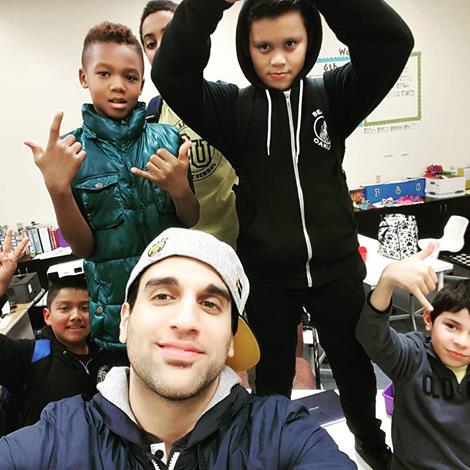
Arash and HHCF students after a day of chess and life strategies class in Oakland, CA.
When examining the architecture of antiquity, one finds plush and radiant mosques from civilizations throughout Africa and contiguous acres that comprised Mesopotamia. But despite the reality of Black cultural representation since the dawn of civilization, images that forge a vast and pervasive influence from Black scholars do not parallel the intellectual ancestry that is generated in school curricula. Given the bounteous presence of conical shapes, pillars with concentric orbs, that stood atop Moorish arches, it stands to reason that today’s STEAM studies could create a more critical literacy of math education by representing the Pan-African contributions to the canon. Education practitioners and policy wonks use false assumptions about math to justify expectations that have more to do with anti-Blackness, ethnicity, national origin and gender, than reasoning and cognitive function. In Schooling for the New Slavery (1978), Donald Spivey asserts that the validity of anti-Black perceptions is fortified by the emergence of White settler education systems. Asa Hilliard furthers this position by recounting cases in which schools have “kept African people away from the data needed to interpret their own cultural and history reality” (1995, p. 189). Black youth are given the imperative to center a revisionist history as the benchmark of success. We treat the curricular mismatch between schools and students as a student deficiency or cultural problem squarely placed upon the shoulders of students with faddish bromides, such as academic grit or personal responsibility. These semantic dodges skirt the implication of schools—as a tool for perpetuating racist ideology—and avoid meaningful discussion about the ecology of anti-Black schooling.
Finally, while Europe struggled to emerge from the Middle Ages, troves of literature demonstrate the unrivaled contributions that African scholars, during that era, made to the field of mathematics and other sciences. Yet, these iconic fixtures are all but removed from Western curriculum. Imagine if students were offered a portal into their intellectual ancestry in math, the same way Spanish immersion allows non-Native English speakers from Spanish-speaking countries to make lateral connections in the classroom. There are thousands of noteworthy contributions that Black scholars have made to mathematics, well before public schools were formally ratified in the Western Hemisphere. Timbuktu gave rise to many differential equations formulas used today by astronomers. These formulas were cultivated during the inception of the Ghanaian Empire (modern Mali) during the 11th and 12th century. Yet, the Treatise of Algebra, scribed 400 years later by John Wallis in 1685, is still revered as the seminal work from which astrophysicists operate. Omar Khayyam, a Persian scholar, is often recalled, as no more than an indulgent Sufi poet from the 11th century, yet he is responsible for finding the intersections between cubic and conic equations, which has influenced the architecture traditionally associated with colonial Spain. In regards to Arab contributions to math B Carra de Vaux wrote “They made algebra an exact science and developed it considerably and laid the foundation of analytical geometry; they were indisputably the founders of plane and spherical trigonometry which, properly speaking, did not exist among the Greeks. “
To create a more equitable school system in which individual identities are not stigmatized, we must have painstaking and honest conversations around the process of academic identification. In order to fully affirm the academic pedigree of mathematics, we must recognize the geopolitical contributions that all cultures have made to its canon. Until then, Black youth will continue to be ensnared by the false binary of “underachievement” and fatalistic trappings of Eurocentric distancing. By stigmatizing and historically abstracting Black ancestry from the academic canon, we manufacture a pathology of Black youth, rather than achievement itself, as in need of restoration.
Adisa Banjoko is the Founder of the Hip-Hop Chess Federation (HHCF). They are the first 501c3 non-profit to fuse music, chess and martial arts to teach STEM, STEAM and Life Strategies. He is the author of the upcoming book Bobby, Bruce & Bam: The Secrets of Hip-Hop Chess. Follow on IG @realhiphopchess
Arash Daneshzadeh is the Director of Education for Hip-Hop Chess Federation and a Professor of Education, in the Organizational Leadership Program at the University of San Francisco. Twitter: https://twitter.com/A_Daneshzadeh




.jpg)


